


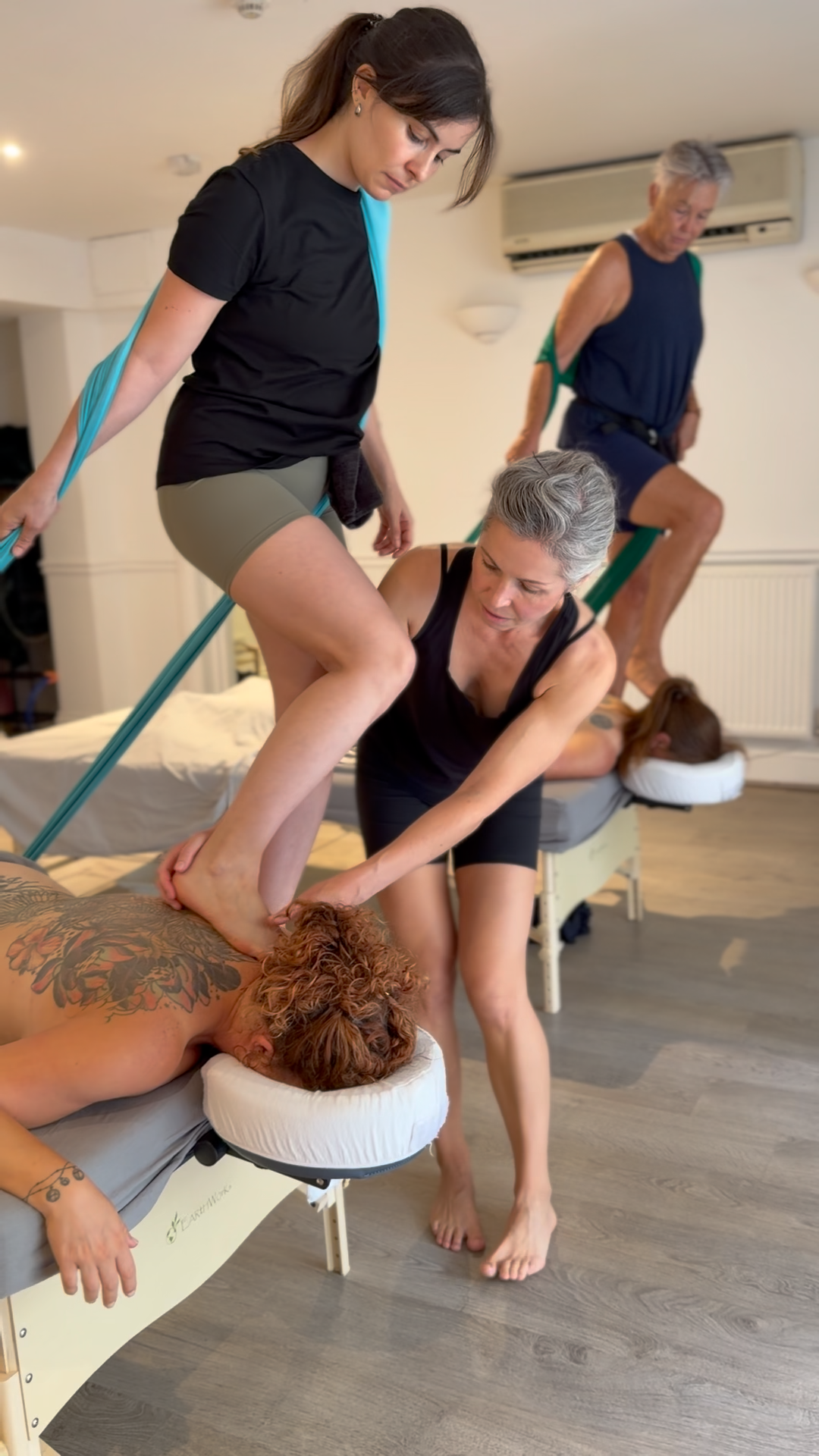
Learn to give deep pressure with your bare feet and protect your hands & wrists.
A self-paced online course for experienced massage therapists, and your first step toward training in person with Helen Jamieson, our first UK instructor in Brighton & Hove.
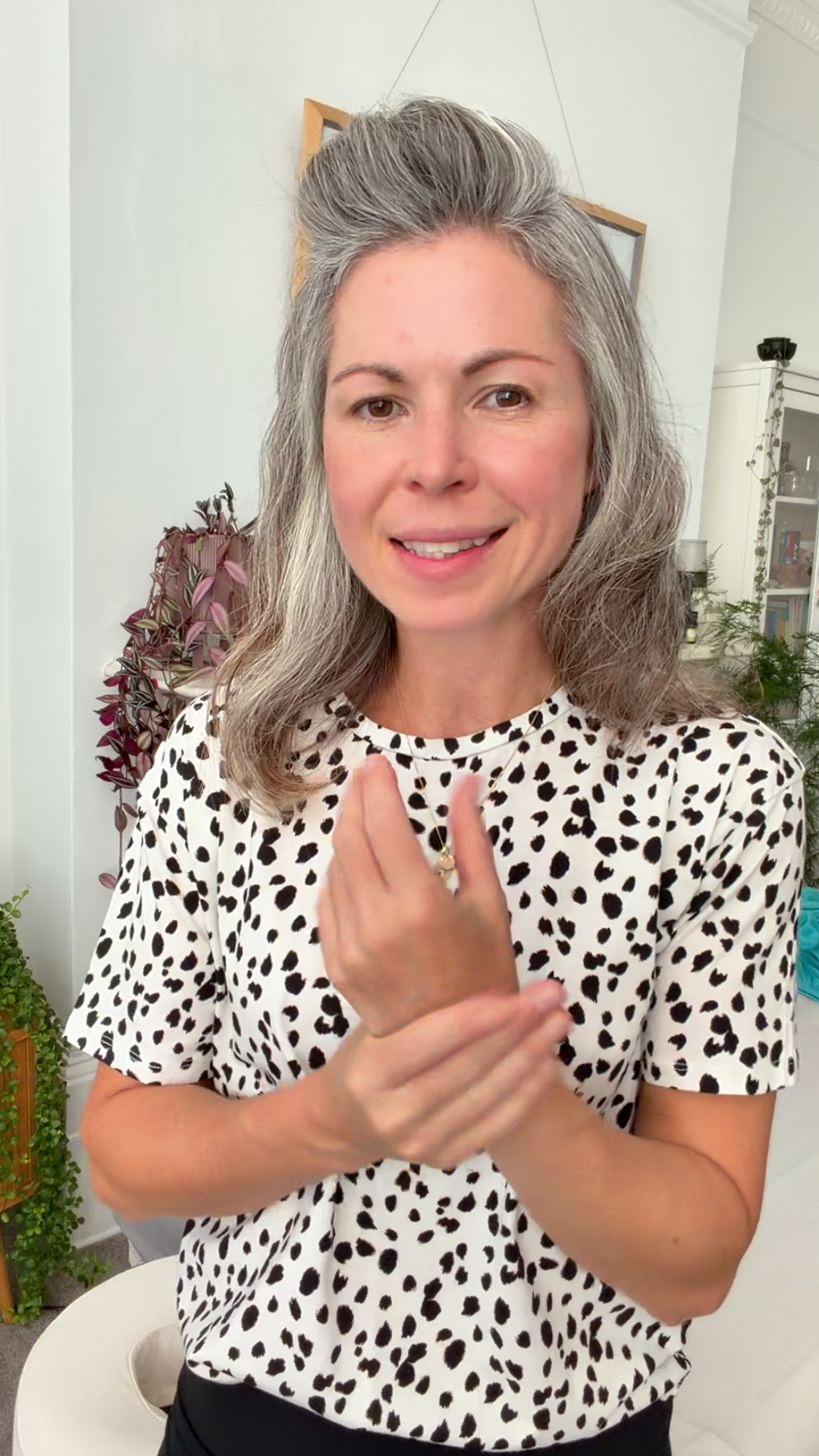
Why I started working with my feet.
After years of deep tissue massage, my hands and wrists were sore at the end of most days. I knew I had to find a different way if I wanted to keep doing the job I love.
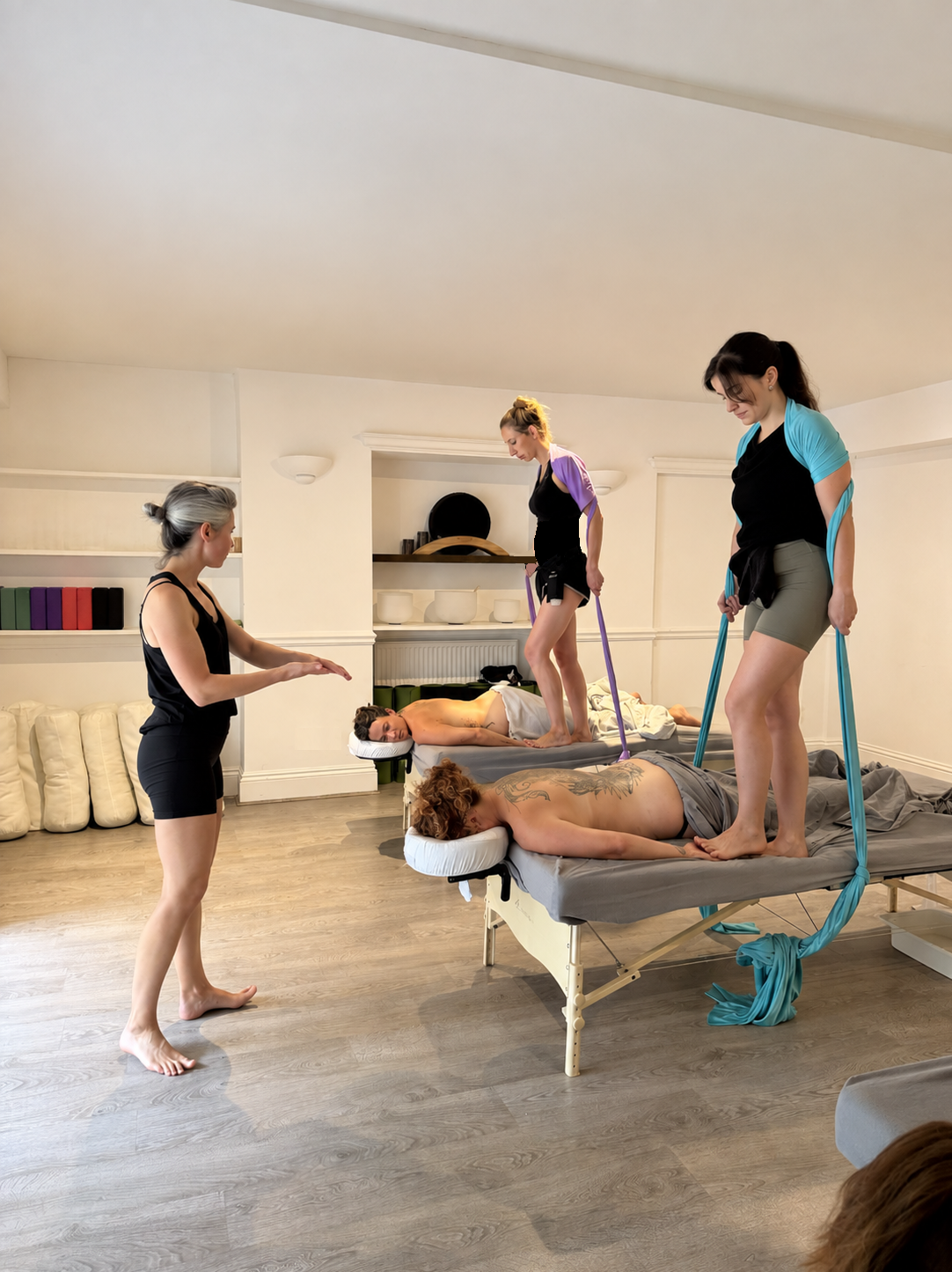
I found it in Sarga Bodywork, where I work with my bare feet and a silk, fastened to the massage table. The silk supports me and creates tensegrity, so my body weight and gravity deliver the pressure rather than my hands and thumbs.
The contact is slow, broad and sustained, and my clients often tell me it feels deep without ever feeling sharp.
Now I finish a full day without feeling tired and sore, and I'm confident I can keep doing this work for many years to come.
Sarga draws on barefoot traditions such as Ashiatsu, Thai massage and barefoot Shiatsu, along with ideas from Structural Integration & Rolfing and brings them together into a method of its own. I loved it enough to train as an instructor, and I'm now the first to teach it here in the UK.
Everything you need to start at your own pace.
Sarga Bodywork Beginner is made up of three courses, which build toward a complete 90-minute Sarga sequence.
What's inside
The course begins on a floor-based setup.
- 8+ hours of video lessons
- Lifetime access on any device
- Downloadable course materials
- Private UK Facebook group
Your path ahead
-
1Learn at home start here
Work through the online course at your own pace, and complete it through the Course Theory Quiz before any in-person training.
-
2Practise
Set up your equipment and spend a month or more getting the sequence into your body.
-
3Train with Helen in Brighton & Hove
Four days of in-person training in Central Hove, in small groups of up to eight. The next course runs from 6 to 9 November, and tuition is £750.
-
4Become certified
Complete your practice sessions and a live online evaluation to become a Certified Sarga Bodywork Practitioner, which means you can offer and promote Sarga in your practice.
Who Sarga Suits
Sarga is designed for experienced massage therapists who love deep, myofascial work and want a way to deliver it that's kinder to their own bodies.
Working with your feet asks a lot of your balance and strength at first, so it comes most naturally to therapists who keep up a movement practice such as yoga, Pilates or dance.
We recommend watching the course up to the Technique section before choosing whether a raised-table or floor-based practice suits you.
From Therapists Who've Trained In Sarga
 Max Mora, MFHT
Integrated Somatics, London
Max Mora, MFHT
Integrated Somatics, London
 Isari Jantharat
Home Holistic Massage, Surrey
Isari Jantharat
Home Holistic Massage, Surrey
From Helen's clients in Hove
Questions?
Do I need to be fit to learn Sarga?
Sarga asks a lot of your balance and strength at first, although it gets easier with practice. As a guide, you should be able to balance on one foot for a minute without support, keep up steady cardio such as jogging or swimming for 10 to 15 minutes, do three sets of 20 squats, and hold a plank for a minute. If you're not there yet, our Sarga Fit online course is designed to build the conditioning the method needs.
Does my height or build matter?
Weight alone doesn't determine fitness or ability, and every Sarga technique is done with one foot at a time, so your full body weight is never on the client. For raised-table training, we ask you to let us know if you weigh under about 45 kg (7 stone) or over about 79 kg (12.5 stone), or if you're 6 feet (183 cm) or taller, so we can make sure the techniques suit you and the table. Floor-based Sarga offers a wider, more stable working area and is often a good option.
Should I learn on a table or on the floor?
The online course begins on a floor-based setup and covers everything that changes on a raised table. Floor work has an easier learning curve and a more stable base. Table work suits therapists whose clients are used to a raised table, and it makes it easier to combine Sarga with hands-on techniques. Helen teaches her in-person course on raised tables.
What equipment will I need, and when?
Nothing to begin. We recommend watching the course up to the Technique section before buying anything, so you understand the setup and safety considerations first. Most practitioners then choose a Sarga Silk along with fittings for either a table or the floor, and the course explains the options.
Can I learn a physical method online?
The online course gives you over eight hours of detailed video, written materials and a private community for questions, and many practitioners build a solid foundation this way. In-person training adds real-time feedback and the chance to feel the techniques yourself, which is why the online course leads on to Helen's four days in Brighton & Hove.
What do I need for Helen's in-person training?
A recognised massage qualification, at least a year of hands-on experience, current professional insurance, and completion of the online course through the Course Theory Quiz.
Can I offer Sarga to my clients after the online course?
To offer and promote Sarga in your practice, you'll need to become a Certified Sarga Bodywork Practitioner. The steps are to pass the course quizzes in the online course, complete 20 practice sessions on at least eight people, pay the certification fee and pass a one-hour live online evaluation with a Sarga instructor.
How long do I have access?
For life! The course is self-paced, so you can work through it on your own schedule and come back to it whenever you need a refresher.

Start Here
Begin with the Sarga Bodywork Beginner Online Course below, then join us for the 4‑day in‑person training.
Ejemplo título de producto
Whether you're new to bodywork or have decades of experience, this self-paced journey welcomes you from anywhere in the world. The course builds toward a complete 90-minute Sarga Bodywork sequence. You'll discover a way of moving that honors both ancient barefoot massage traditions and current fascia research. Through sustained, intentional contact and mindful pacing, you'll learn how slow movement creates space for fascia to respond on its own terms.
Connect With Us
Join our UK Facebook Group
This is a private Facebook group for massage therapy professionals with an aim to provide resources and networking for barefoot massage practitioners in the UK. This group also provides course support, trade tips as well as certification guidelines for Sarga Bodywork.
Join our UK WhatsApp Group
This WhatsApp group is a platform for short form communication and networking for students interested in and registered for upcoming in-person courses in the UK.